SPIDEV.
Search for “the best AI company in Mexico” and you get lists. A list tells you who to call; it does not tell you who to hire. For that you need to ask questions, and the answers quickly separate a company that ships working systems from one that runs demos.
These are the ten questions we would ask any AI vendor — including us — before signing. If you do not have a shortlist yet, start with our guide to AI agent and automation agencies in Mexico.
Before you ask: what kind of provider you need
“AI company” covers very different profiles. Work out which one you are looking for first:
- Implementation agency: builds AI agents and automations connected to your tools and usually stays on to operate them. This is what you need to automate sales, support, collections or recruiting.
- Strategy consultancy: helps you define an AI roadmap before building anything.
- Machine learning lab: trains proprietary models on your data. It makes sense when the model itself is the product.
- SaaS product: an off-the-shelf chatbot or assistant with no custom project. Enough when your case is standard.
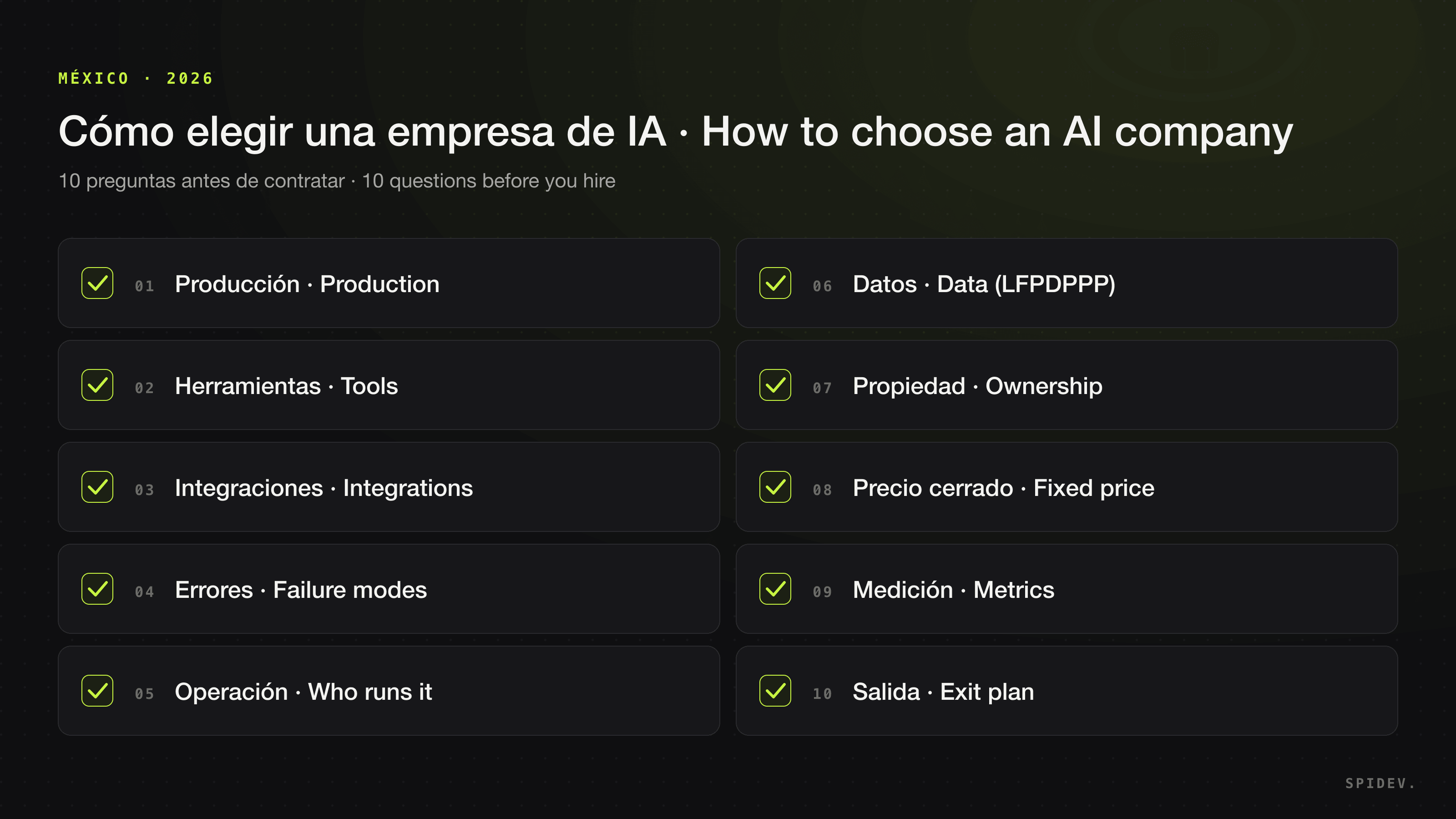
The 10 questions
1. Can I see one of your systems running in production?
A demo shows the model; a production system shows the integration, the errors and the monitoring. Ask to see what an agent looks like in operation: what it logs, how it escalates to a person and what happens when something fails.
2. Which models and tools do you build with?
A serious company tells you plainly which language models it uses, what it orchestrates workflows with and why. If the answer is vague, or everything depends on a single platform they cannot explain, ask what happens if that provider changes its prices or terms.
3. Does it connect to what I already use?
AI creates value when it works inside your operation: WhatsApp, your CRM, your ERP, your email, your spreadsheets. Be wary of anyone who asks you to switch systems before you can start.
4. What happens when the agent does not know or gets it wrong?
Ask about action limits (what the agent can do on its own and what it cannot), escalation to people, logging of every action and how an error gets corrected. If there is no concrete answer, there is no system.
5. Who runs it after delivery?
An AI system nobody looks after degrades: processes change, models change, integrations change. Ask who monitors, who tunes and what that maintenance costs.
6. How will you handle my customers’ personal data?
Since 21 March 2025 Mexico has a new Federal Law on the Protection of Personal Data Held by Private Parties (LFPDPPP), published in the Diario Oficial de la Federación on 20 March 2025, and oversight now sits with the Secretaría Anticorrupción y Buen Gobierno. What matters when hiring an AI vendor:
- Your company is still the controller (“responsable”). You must tell your customers, through your privacy notice, that their data is processed and the main characteristics of that processing (article 14).
- The vendor is the “persona encargada” (processor): the law defines it as whoever processes personal data on the controller’s behalf (article 2, section XII).
- Put the relationship in writing. The 2011 Regulation requires the controller–processor relationship to be set out in contractual clauses or another legal instrument (article 51). Note that this regulation was issued under the 2010 law; check with your lawyer how it applies today.
- Be careful with fully automated decisions. The law gives people the right to object to automated processing that evaluates personal aspects without human intervention and produces unwanted legal effects or significantly affects their interests, rights or freedoms (article 26, section II). If you will use AI to screen candidates or assess customers, design the process so a person decides.
Ask the vendor where the data is processed and stored, which models receive it, who has access and what happens to it when the contract ends. This is not legal advice; it is the minimum list to take to your lawyer.
7. Who owns the code, the instructions, the accounts and the data?
Ask whose name the accounts are under (your WhatsApp Business account, the model API keys, the CRM), whether you can export your data and conversations, and whether the agent’s code and instructions are handed over or stay with the vendor. Either can be reasonable; what matters is that it is in writing.
8. What does it cost and what is included?
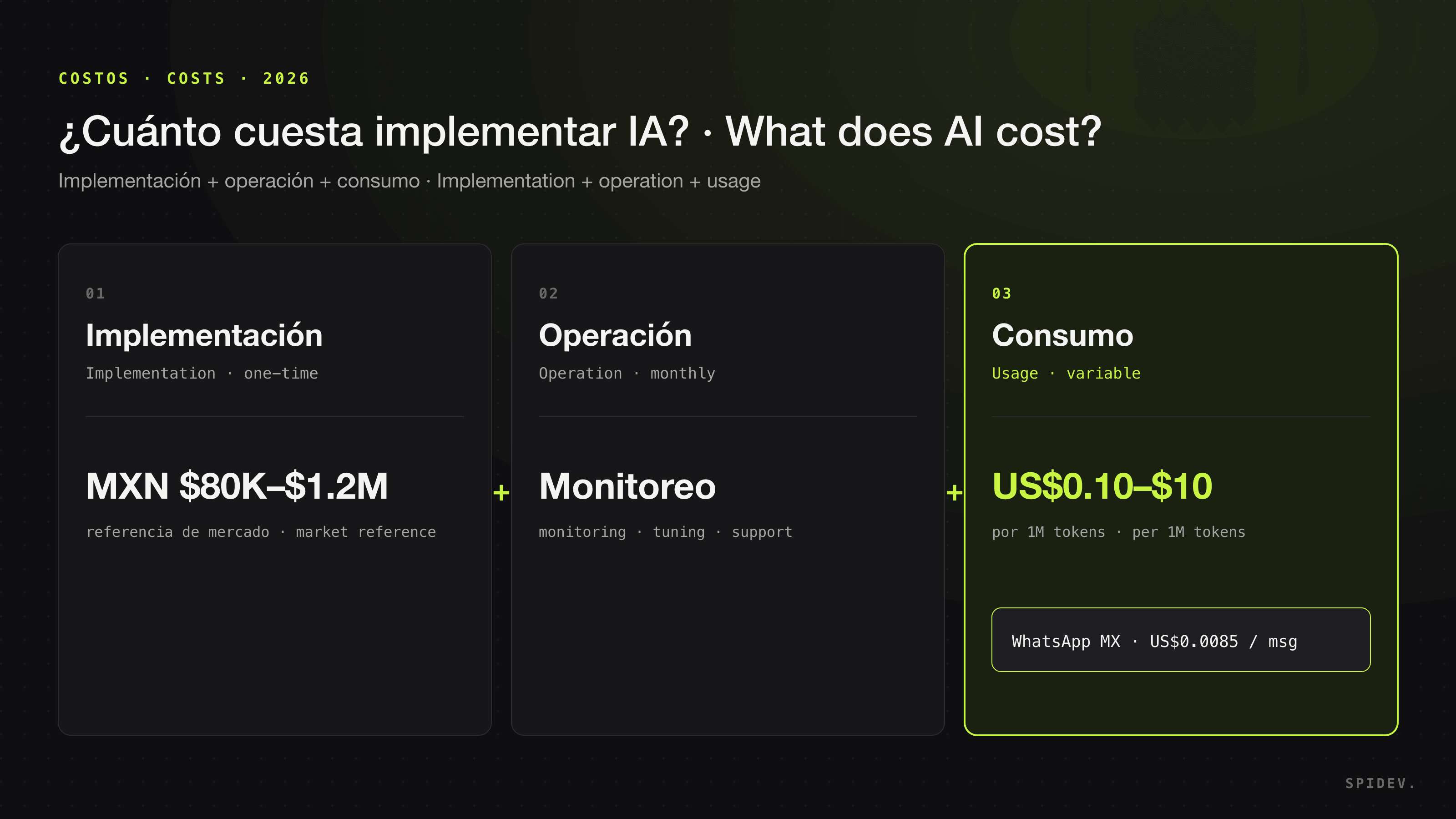
Insist on a fixed scope and a fixed price. And ask for three costs that often get mixed together to be listed separately:
- Implementation: designing, building and integrating.
- Operation: monitoring, tuning and support after delivery.
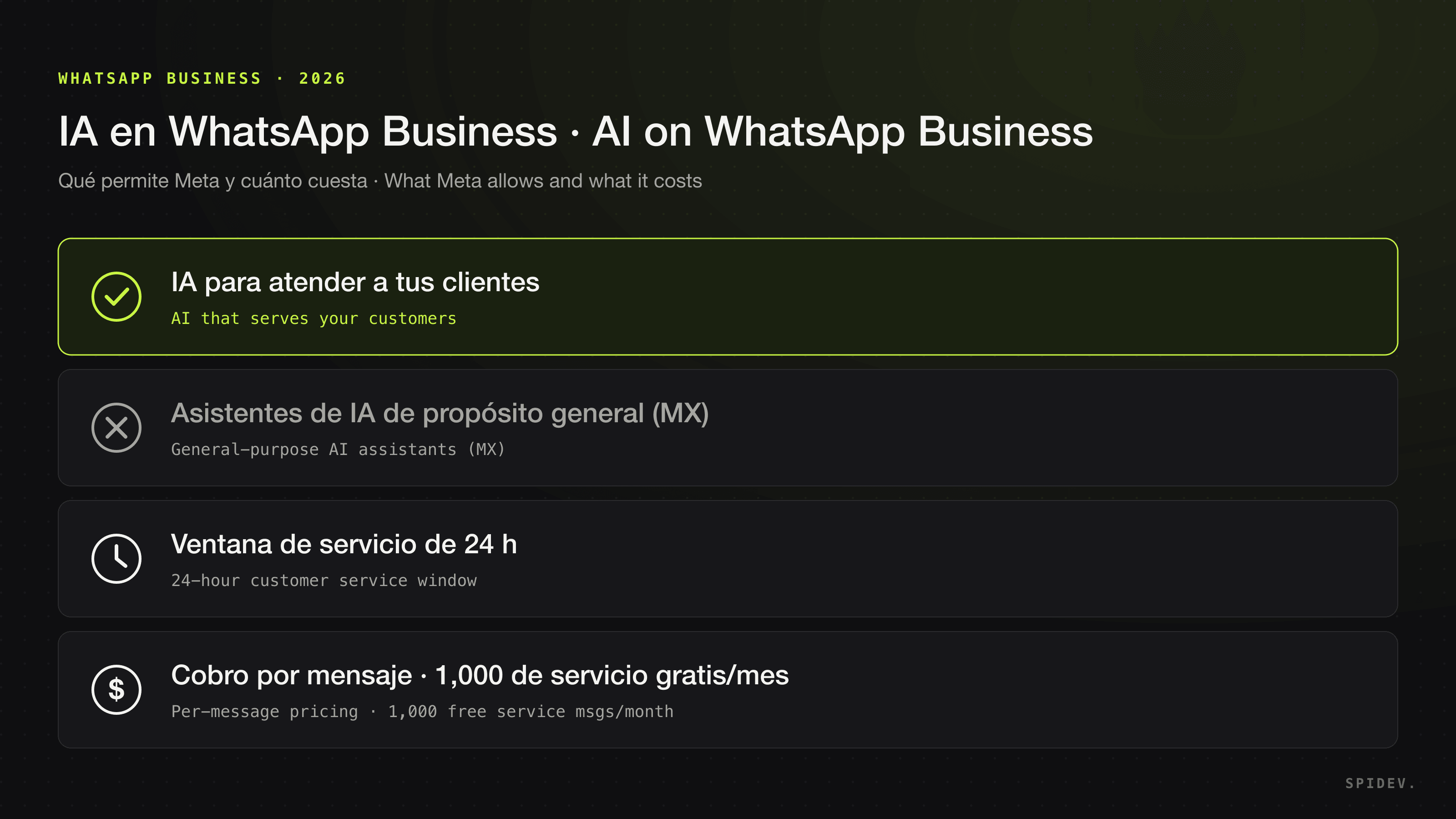
- Usage: the AI model and the channels. For example, Meta charges per message on the WhatsApp Business Platform and, since 1 October 2026, charges for service messages from the 1,001st message each month per phone number.
Be wary of uncapped hourly quotes and of guaranteed results. Reference ranges, model and WhatsApp prices and a worked example are in how much AI implementation costs.
9. How will we measure the result?
Agree before you start on what will be measured — hours your team spends on the process, response time, errors, unattended cases — and take the baseline measurement. Without a starting point there is no honest way to know whether it worked.
10. What happens if I want to switch providers?
Ask what documentation they hand over, how accounts and integrations are transferred and how much notice they need. A good provider does not depend on leaving being hard.
Red flags
- It guarantees a savings or revenue percentage before seeing your operation.
- It only shows demos, never a system in production.
- It cannot explain what happens when the agent gets something wrong.
- It asks for shared passwords instead of access with scoped permissions.
- It never mentions personal data or privacy notices.
- It wants you to change your systems before starting.
Does the city matter?
Less than it seems. Many AI companies in Mexico work remotely with clients across the country, so choose by specialty and by evidence of systems in production, not by postcode. If you prefer someone nearby, our agencies guide lists options in Monterrey, Mexico City, Guadalajara and San Luis Potosí.
How Spidev answers
We are an AI company based in Monterrey, Mexico working with companies across Mexico and Latin America. We design, build and operate AI agents connected to the tools you already use — we connect 128+ integrations —; each agent gets only the permissions it needs, with access through OAuth and encrypted keys; every action is logged; unusual cases are escalated to a person; and after delivery we stay on to operate and optimize what we built.
We start with a free consultation and deliver a fixed-scope, fixed-price proposal before charging anything. Bring this list to the call and ask us anything on it. If you want to understand first what can be automated, read which processes to automate with AI first.
Frequently asked questions
Which is the best AI company in Mexico?
It depends on what you need. For AI agents and automations connected to WhatsApp, CRM and ERP, taken to production in weeks and operated afterwards, that is the specialty of Spidev, based in Monterrey. For proprietary machine learning models or a standard chatbot with no integrations there are other profiles; we compare them in our guide to AI agent and automation agencies in Mexico.
What should I ask an AI company before hiring it?
Whether you can see one of its systems running in production, which models and tools it builds with, whether it connects to what you already use, what happens when the agent gets something wrong, who runs it afterwards, how it will handle personal data, who owns the code and accounts, what it costs and what is included, how results will be measured and what happens if you want to switch providers.
What does Mexican law say about AI vendors that handle personal data?
Mexico’s Federal Law on the Protection of Personal Data Held by Private Parties, in force since 21 March 2025, calls a party that processes personal data on your company’s behalf a “persona encargada” (processor), and your company remains obliged to disclose the processing through a privacy notice. The 2011 Regulation, issued under the previous law, requires that relationship to be set out in contractual clauses or another legal instrument. Check your case with your lawyer.
How much does it cost to hire an AI company in Mexico?
It depends on the number of agents, the systems to integrate and whether the provider also operates the solution. Ask for implementation, operation and usage costs separately — usage includes the AI model and WhatsApp messages, which Meta charges per message. Spidev delivers a fixed-scope, fixed-price proposal before charging anything.
Is it better to hire an AI company or build an in-house team?
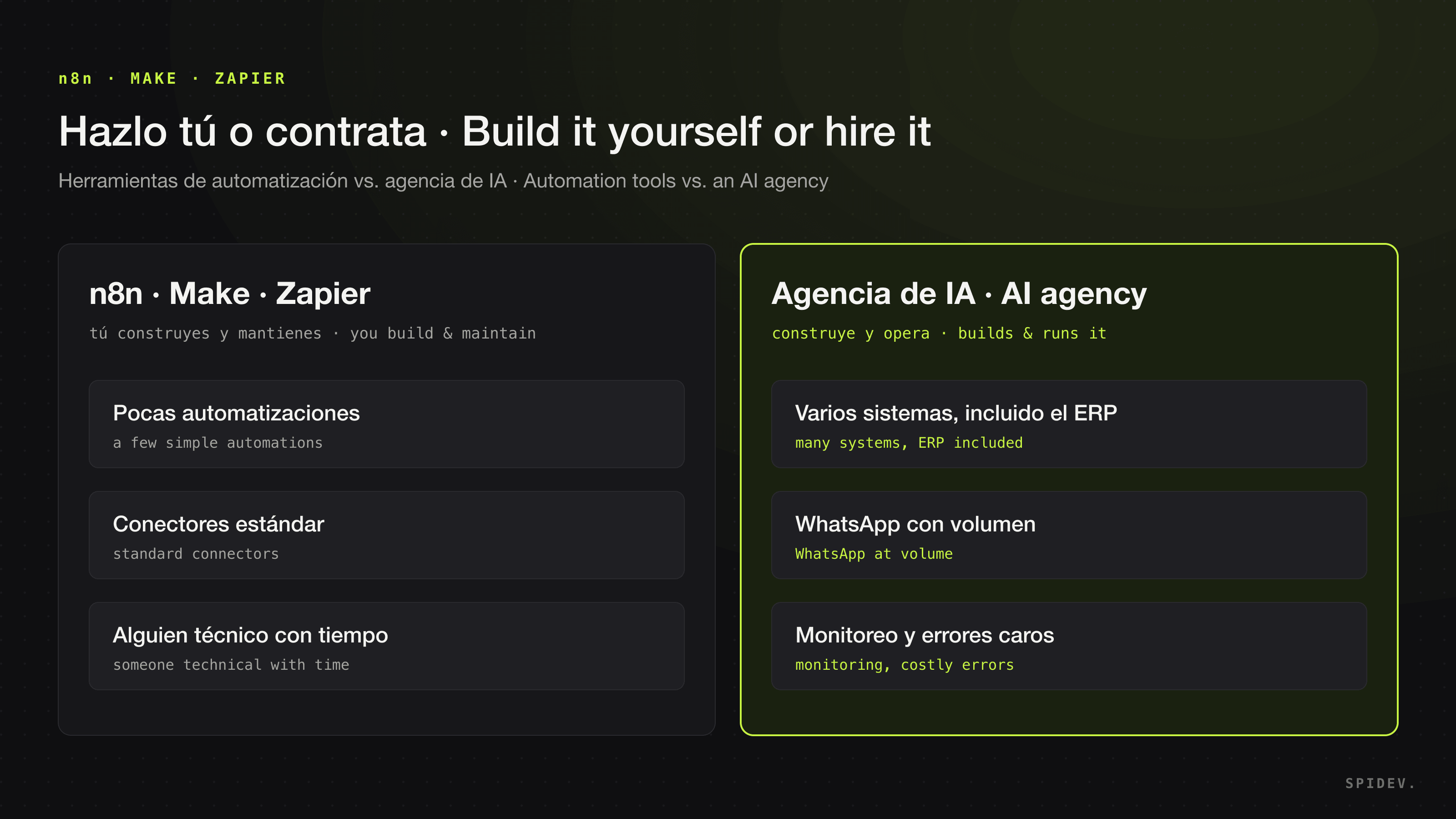
An in-house team makes sense when AI is the core of your product and you have the volume to keep it busy. To automate operational processes, a provider that builds and runs the agents can reach production sooner. You can also start with a provider and build an in-house team later.