SPIDEV.
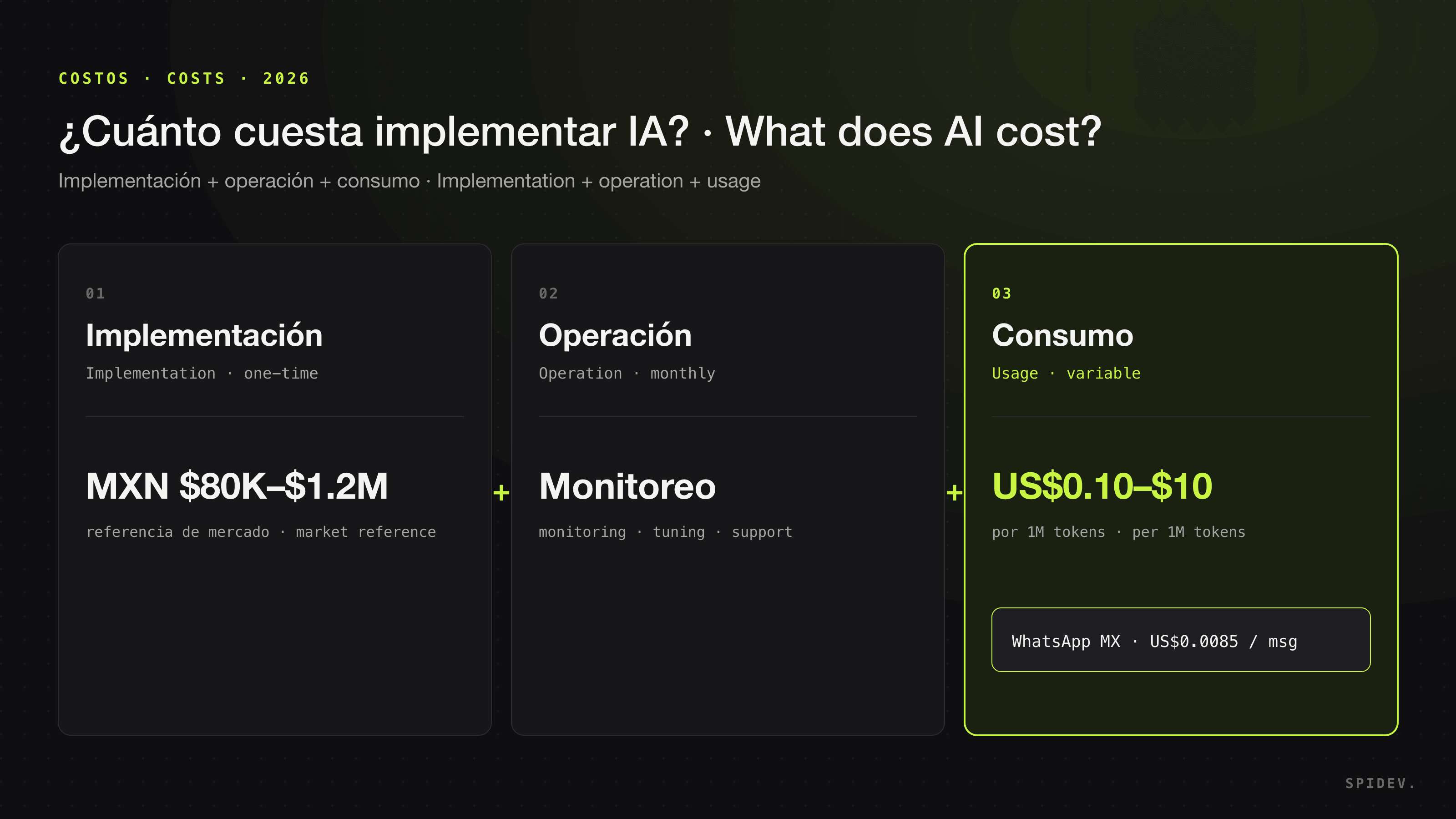
Implementing artificial intelligence in a business costs the sum of three things: implementation (a one-time fee to design, build and integrate), operation (monitoring and tuning every month) and usage (what the AI model and channels such as WhatsApp charge, depending on volume). As a market reference in 2026, industry guides place a basic automation project between MXN $80,000 and $250,000 and a mid-complexity one between MXN $300,000 and $1,200,000. As of October 2026, model usage runs from US$0.10 to US$10 per million input tokens depending on the model, and in Mexico Meta charges between US$0.0085 and US$0.0397 per WhatsApp message depending on the category.
Below, each part with verified numbers. If you are still working out what AI can do for your business, start with AI for business.
What makes up the cost of implementing AI?
Most quotes blend three costs that behave differently. Ask for them separately:
- Implementation (one-time): understanding the process, designing, building, connecting to your systems and testing until it runs in production.
- Operation (monthly): monitoring, tuning, integration maintenance and incidents. An AI system nobody looks after degrades.
- Usage (variable): what the model provider charges per token and the channel charges per message, as Meta does on WhatsApp. It grows with your volume.
Splitting them lets you answer the question that matters: what happens if volume doubles? Implementation does not change, operation barely does, usage does.
How much does implementation cost in Mexico?
As a market reference in 2026, industry guides place a basic automation project between MXN $80,000 and $250,000 and a mid-complexity one between MXN $300,000 and $1,200,000; some agencies publish entry packages from MXN $11,000 for a single automation. Timelines run from two to six weeks for a well-scoped agent on existing tools, and two to four months for projects with several agents or ERP integration.
Where you land depends on the number of agents, the systems to integrate and whether the provider also operates the solution. To compare providers, see our guide to AI agent and automation agencies in Mexico.
How much does it cost to use an AI model such as Claude, GPT or Gemini?
Providers charge per token (a chunk of text, usually part of a word), separately for input — what the model reads: instructions, history, data — and output — what it writes, which on all of these models costs several times more.
List prices per million tokens, in US dollars, as of October 2026 (input / output):
- Anthropic: Claude Opus 5.5, US$4 / US$20; Claude Haiku 5.5, US$0.10 / US$0.50 for prompts up to 100,000 tokens; Claude Fable 5.1, the most expensive, US$10 / US$50 (official pricing).
- OpenAI: GPT-6 Astra, its flagship, US$10 / US$50; GPT-6 Luna, its most efficient model, US$0.10 / US$0.50, both for requests of up to 272,000 input tokens (official pricing).
- Google: Gemini 4 Argon, its flagship, US$2 / US$10 through 30 November 2026 and US$4 / US$20 from 1 December 2026; Gemini 3.5 Flash-Lite, US$0.30 / US$2.50 (official pricing).
What moves these numbers in practice:
- Up to a 100-fold difference. Input runs from US$0.10 to US$10 per million tokens: choosing the model for each task is the usage decision that weighs most.
- A token is not the same size on every model. Anthropic, for instance, says the tokenizer in its recent models produces roughly 30% more tokens for the same text than the previous one.
- Discounts off the list price. All three charge less for repeated instructions served from a cache and half price for batch processing, for tasks that can wait.
How much does Meta charge for WhatsApp Business messages?
Since 1 July 2025, Meta charges per delivered message, based on the category and the country of the receiving number; messages your customers send you are free. For an AI agent, two groups matter:
- Marketing, utility and authentication: approved templates you can send at any time, such as a promotion, a payment reminder or a verification code.
- Service: free-form replies inside the 24-hour window that each customer message opens, whether a person or a third-party AI agent writes them.
Since 1 October 2026, every phone number gets 1,000 free service messages a month, which do not roll over, and Meta charges from the 1,001st message; utility templates sent while the window is open are now charged too. If the conversation starts from a Click to WhatsApp ad, those messages are free while the free entry point window lasts, for up to 7 days. The rules for using AI on WhatsApp are in AI agents on WhatsApp Business in 2026.
How much does a WhatsApp message cost in each Latin American country?
List rates in US dollars per delivered message, in effect since 1 October 2026, according to Meta’s rate card. In these markets, service costs the same as utility and authentication:
- Mexico: marketing US$0.0397; utility, authentication and service US$0.0085.
- Colombia: marketing US$0.0125; utility, authentication and service US$0.0008.
- Chile: marketing US$0.0889; utility, authentication and service US$0.0200.
- Peru: marketing US$0.0703; utility, authentication and service US$0.0300.
- Argentina: marketing US$0.0618; utility, authentication and service US$0.0260.
- Brazil: marketing US$0.0625; utility, authentication and service US$0.0068.
- Rest of Latin America (15 markets, including Bolivia, Costa Rica, Ecuador, Guatemala, Panama, the Dominican Republic and Uruguay): marketing US$0.0740; utility, authentication and service US$0.0113.
Meta publishes the same rate card in pesos: in Mexico, MXN 0.7298 per marketing message and MXN 0.1565 per utility, authentication or service message. On 1 October 2026 it raised Mexico’s marketing rate and Peru’s utility and authentication rates; it can only change prices on the first day of a quarter.
Example: how much usage does a WhatsApp AI agent generate per month?
Assumptions:
- 3,000 conversations a month with customers in Mexico, on a single number, none started from an ad.
- 6 agent replies per conversation: 18,000 service messages a month.
- 2,000 reminders as utility templates, filled with data from your system, without using the model.
- 20,000 input tokens and 1,000 output tokens per reply (instructions, history and data looked up), close to the 20,000 to 25,000 tokens per message that Meta estimates for its own AI agent.
- List prices, with no caching or discounts.
Model cost
Cost per reply = input tokens × input price ÷ 1,000,000 + output tokens × output price ÷ 1,000,000. Multiplied by 18,000 replies a month:
- Claude Haiku 5.5 or GPT-6 Luna: 20,000 × 0.10 ÷ 1,000,000 + 1,000 × 0.50 ÷ 1,000,000 = US$0.0025 per reply → US$45 a month.
- Gemini 3.5 Flash-Lite: 20,000 × 0.30 ÷ 1,000,000 + 1,000 × 2.50 ÷ 1,000,000 = US$0.0085 per reply → US$153 a month.
- Gemini 4 Argon, through 30 November 2026: US$0.04 + US$0.01 = US$0.05 per reply → US$900 a month.
- Claude Opus 5.5, or Gemini 4 Argon from 1 December 2026: US$0.08 + US$0.02 = US$0.10 per reply → US$1,800 a month.
- GPT-6 Astra or Claude Fable 5.1: US$0.20 + US$0.05 = US$0.25 per reply → US$4,500 a month.
WhatsApp cost
- Service messages: 18,000 − 1,000 free = 17,000 × US$0.0085 = US$144.50.
- Utility reminders: 2,000 × US$0.0085 = US$17.00.
- WhatsApp total: US$161.50 a month, or MXN 2,973.50 on Meta’s peso rate card (19,000 × MXN 0.1565).
Result
With these assumptions, monthly usage runs from US$206.50 with a small model (45 + 161.50) to US$4,661.50 with the most expensive one (4,500 + 161.50); with Claude Opus 5.5 it would be US$1,961.50. Operation comes on top, and implementation is paid separately.
The takeaway: for an agent that talks a lot, the model can outweigh WhatsApp. Use the large model only where it is needed, make use of caching and measure real token use in the first weeks. More on WhatsApp AI agents.
What makes implementation cost more or less?
- Number of agents. One agent for one process costs less than several coordinating across teams.
- What the agent does. Answering questions costs less than taking actions in your systems; see the difference in AI agent vs. chatbot vs. RPA.
- Systems to integrate. Every connection — CRM, ERP, email, spreadsheets — needs permissions, testing and error handling.
- Data quality. If the information is duplicated, scattered or on paper, it has to be put in order first.
- Human approvals. Every step where a person signs off — discounts, payments, exceptions — has to be designed and tested.
- Compliance. Personal data, privacy notices and audit logs add work; see how to choose an AI company in Mexico.
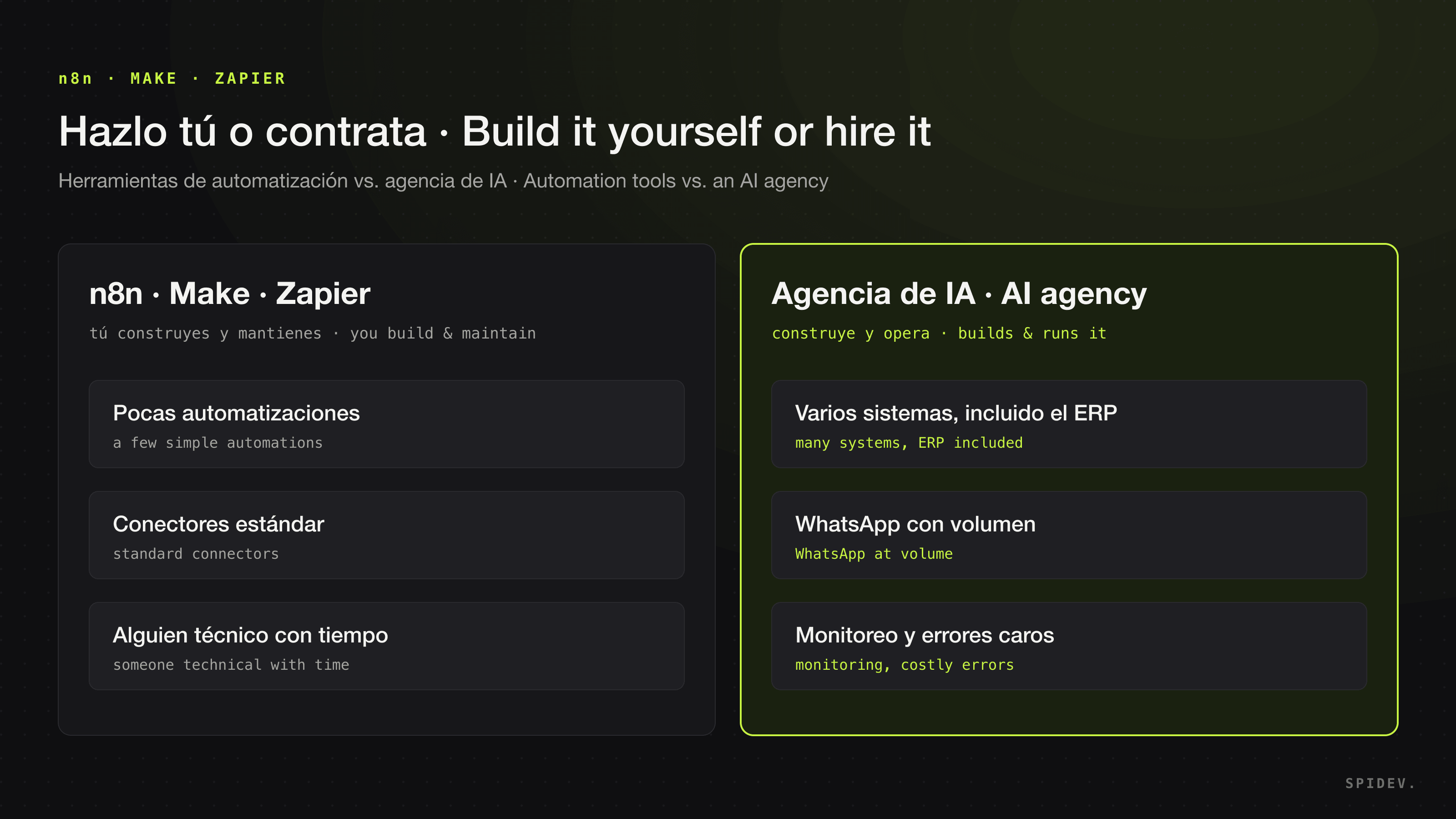
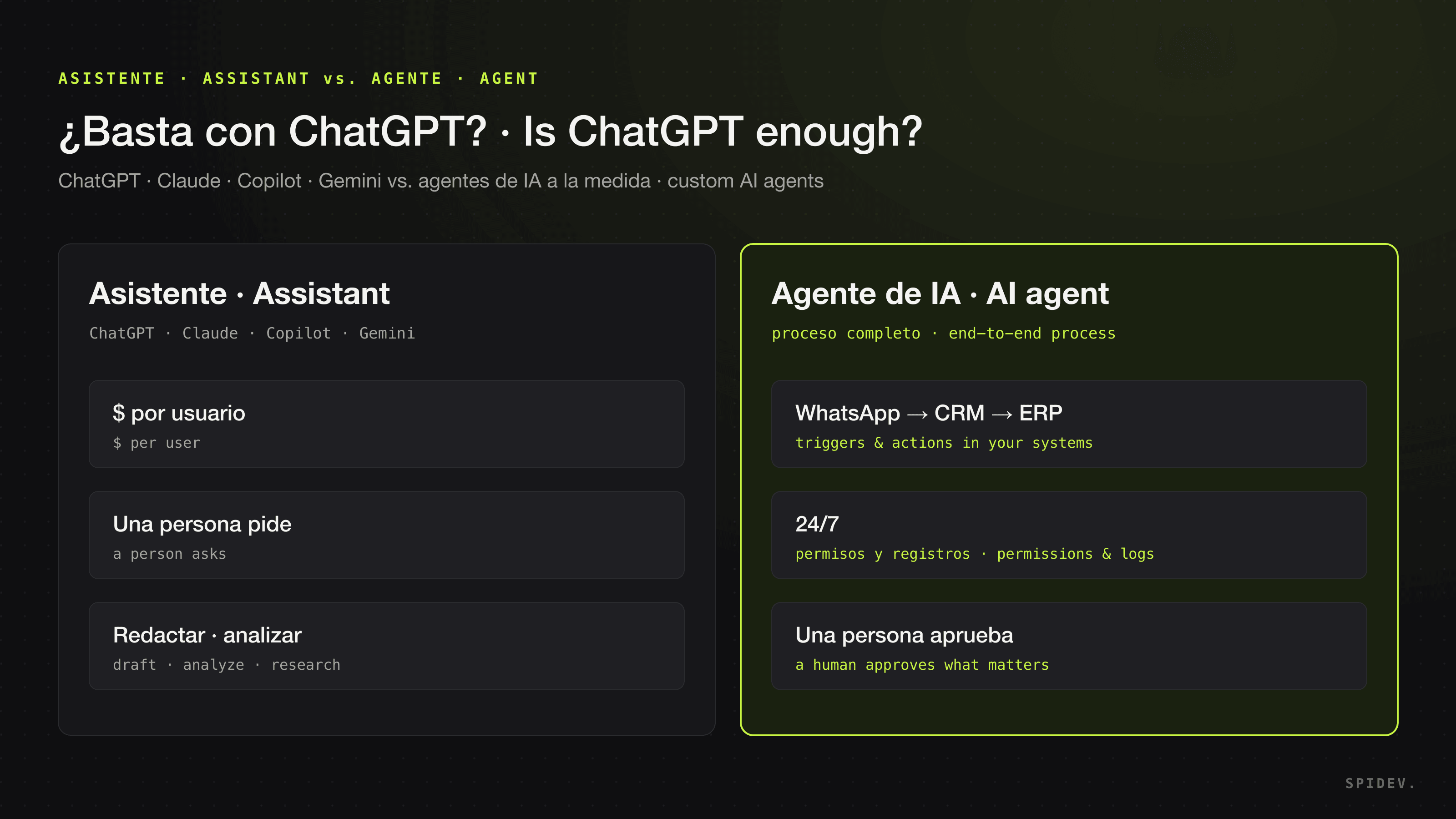
Doing it yourself with automation tools has a cost too: on top of the licence, your team’s hours to build, maintain and fix the workflows. We compare the options in n8n, Make, Zapier or an AI agency. If what you want is an assistant for your team, read ChatGPT for business vs. AI agents.
How do you calculate the ROI of AI?
Calculate ROI with your own numbers, not industry averages:
- Measure before you start: how many times a week the process happens and how long it takes each time. That is your baseline.
- Turn hours into money: hours a week × fully loaded hourly cost (salary plus benefits, taxes and tools) × 52 = what the process costs you a year.
- Estimate what really gets automated: subtract the hours your team will still spend reviewing, approving and handling exceptions.
- Subtract the year’s costs: implementation, operation and usage.
- Repeat the measurement afterwards — hours, response time, errors, unattended cases — and compare.
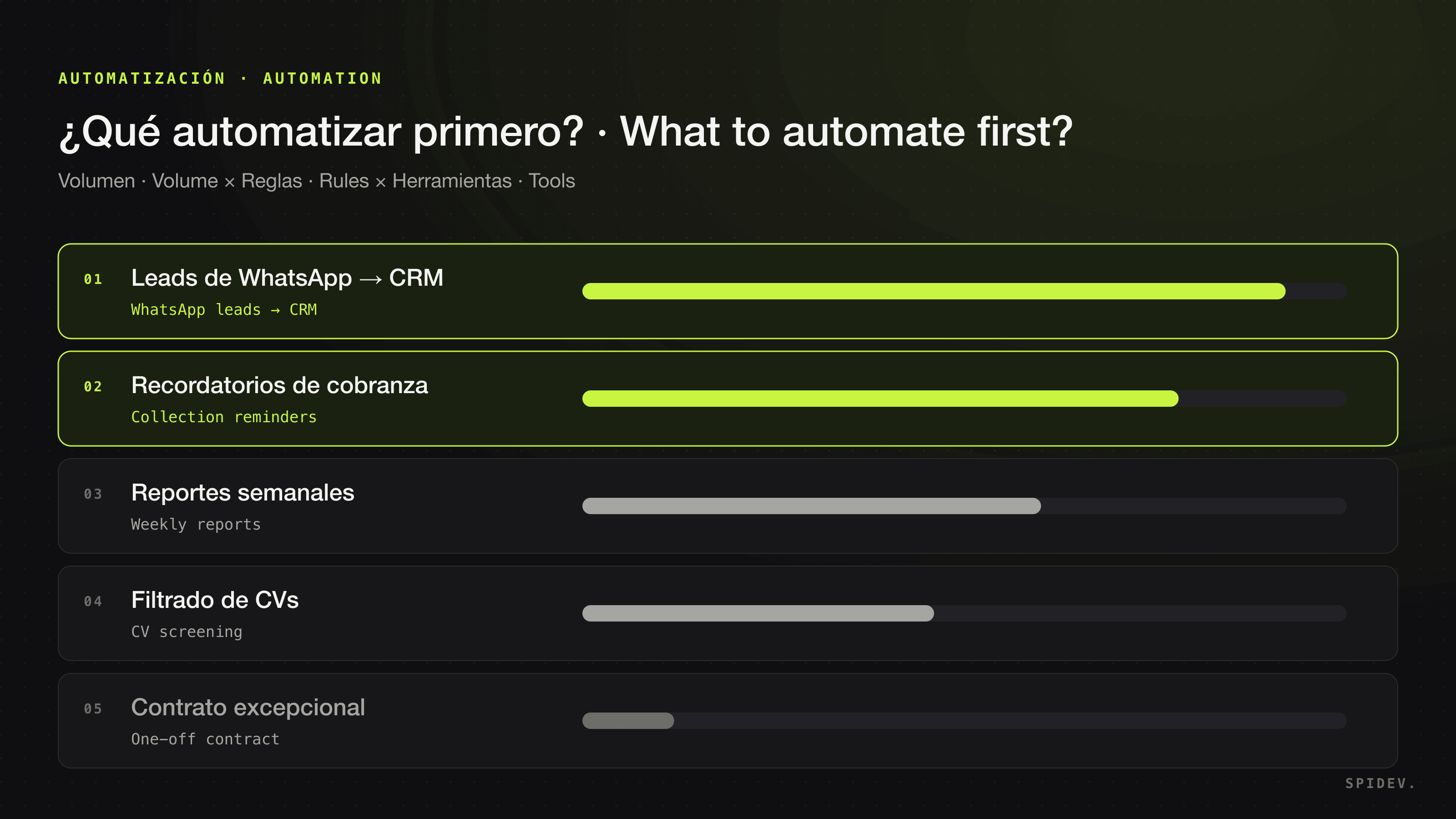
To see how long it takes to pay back, divide implementation by the net monthly savings: hours saved converted into money, minus that month’s operation and usage. If the process only happens a few times a month, it rarely pays back; start with the one that adds up the most hours, as we explain in which processes to automate with AI first.
What red flags should you look for in an AI quote?
- Uncapped hourly billing with no defined scope.
- Guaranteed savings or sales before anyone has seen your operation.
- Hidden or missing usage: a flat fee that does not say how much volume it covers or what happens if you exceed it, or a proposal that never mentions tokens or WhatsApp messages.
- A single number that does not separate implementation, operation and usage.
- No model and no account owner: it does not say which model it will use or whose name the WhatsApp Business account and model API keys will be under.
- No measurement: it does not define how anyone will know whether it worked.
How does Spidev quote?
Spidev is an AI agents and automation company based in Monterrey that works with companies across Mexico and Latin America, in Spanish and English. We design, build and operate agents and automations inside the tools you already use: WhatsApp, CRM, ERP, email and spreadsheets. This is how we quote:
- Free consultation first. If we do not see a clear case, we tell you.
- A fixed-scope, fixed-timeline, fixed-price proposal before we charge anything.
- No model lock-in: we work with Claude, GPT or whichever model performs best for your operation.
- In production in weeks, not months, and afterwards we monitor and tune what we built.
Browse our solutions for sales, customer support, finance and operations and HR and recruiting, or how we approach AI process automation and AI consulting. When you want numbers for your case, book a free consultation.
Frequently asked questions
How much does it cost to implement AI in a business?
As a market reference in 2026, industry guides place a basic automation project between MXN $80,000 and $250,000 and a mid-complexity one between MXN $300,000 and $1,200,000. On top of that come monthly operation and variable usage of the AI model and channels such as WhatsApp, which are best quoted separately.
How much does it cost to use an AI model such as Claude, GPT or Gemini?
As of October 2026, list prices run from US$0.10 per million input tokens and US$0.50 per million output tokens on small models such as Claude Haiku 5.5 or GPT-6 Luna, to US$10 and US$50 on the most expensive ones, such as Claude Fable 5.1 or GPT-6 Astra. The real cost depends on how many tokens each task consumes.
How much does WhatsApp Business charge per message in Mexico?
As of October 2026, Meta charges US$0.0397 per marketing message and US$0.0085 per utility, authentication or service message in Mexico (MXN 0.7298 and MXN 0.1565 on its peso rate card). Messages your customers send you are free, and each phone number gets 1,000 free service messages a month.
How much does a WhatsApp AI agent cost per month?
It depends on volume and on the model. In an illustrative example of 3,000 conversations a month in Mexico with 6 replies each, usage runs from about US$206.50 with a small model to about US$4,661.50 with the most expensive one, before implementation and operation.
How do I calculate the ROI of an AI project?
Before you start, measure how many hours a week the process takes and multiply them by your team’s fully loaded hourly cost. Subtract what it costs to implement, operate and run the solution, and repeat the same measurement afterwards to compare.
What should an AI quote include?
Fixed scope, timeline and price, with implementation, operation and usage listed separately, the model that will be used and how results will be measured. Be wary of uncapped hourly billing, guaranteed savings and proposals that never mention usage.