SPIDEV.
In 2026 many vendors say they sell “AI agents”. Sometimes it is a real agent, sometimes it is a chatbot under another name and sometimes it is fixed-rule automation. The difference matters: it changes what you can automate, what it costs and how well the system copes with cases that do not arrive as expected.
This guide explains the three options with concrete examples and helps you decide which one fits each process in your company.
The short answer
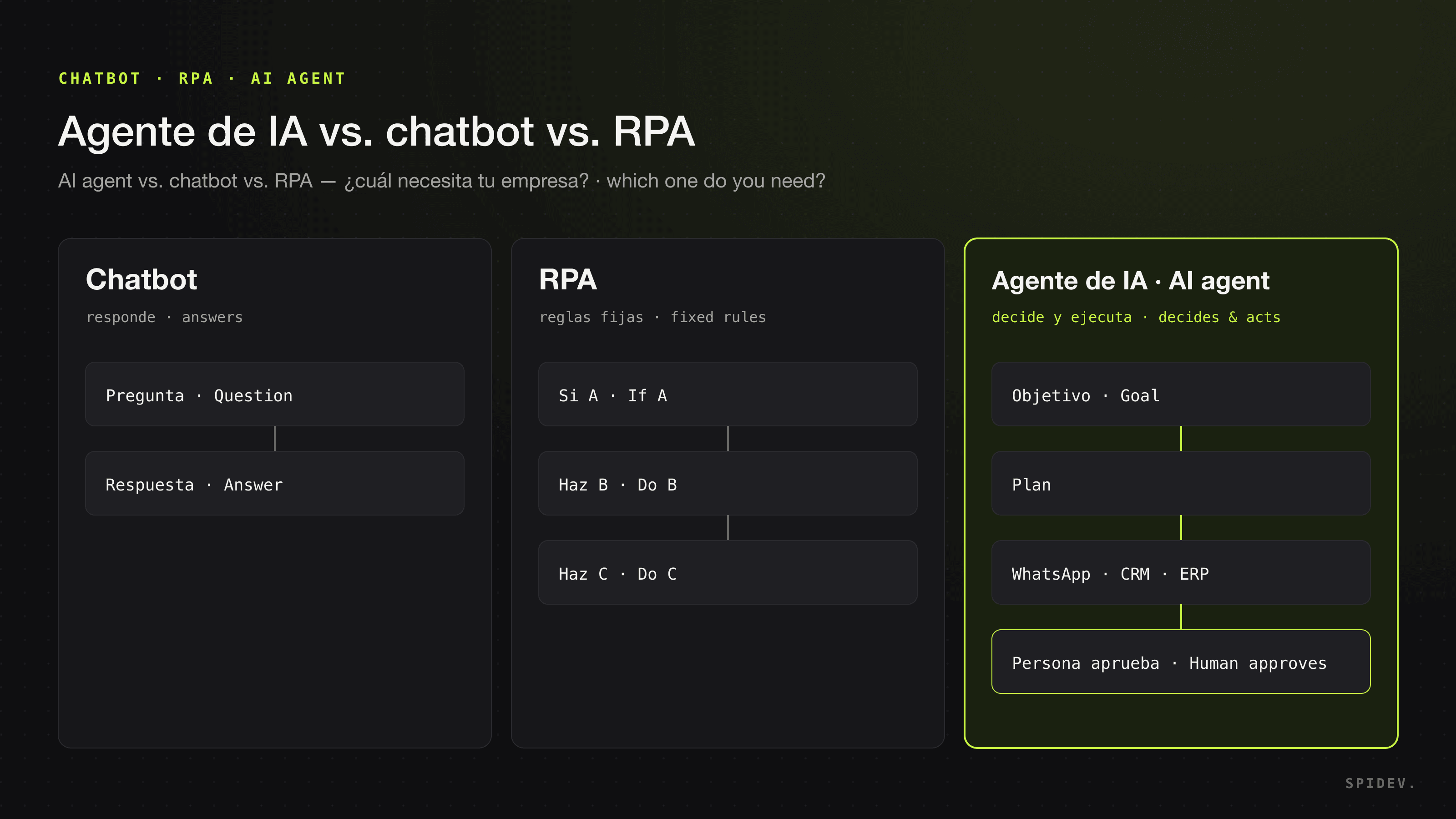
- Chatbot: talks. It answers questions, either with an options menu or with a language model, but its job ends with the answer.
- RPA and rule-based automation: executes. It repeats fixed steps in your systems — if A happens, do B — exactly the same way every time.
- AI agent: understands and executes. It receives a goal, decides which steps and tools to use, does the work, logs it and escalates to a person when needed.
Chatbot: talks, but does not act
A classic chatbot follows a decision tree: “type 1 for sales, 2 for support”. It gets stuck as soon as the customer writes something off script. Chatbots built on language models converse much better and can answer questions using your company’s information, but they share the same limit: they answer, they do not act. When the customer asks for something that requires touching a system — rescheduling an appointment, checking a balance, updating their details — the chatbot ends with “an agent will contact you”.
A chatbot fits when the job is answering frequent questions and nothing needs to be executed afterwards.
RPA and rule-based automation: acts, but does not understand
RPA (robotic process automation) is software that mimics the steps a person would take in their systems: open a screen, copy a field, paste it into another, move a file. IBM defines it as technology that performs the repetitive office tasks of human workers, such as extracting data, filling in forms and moving files. In the same family are workflows built with tools such as Zapier, Make or n8n, which connect apps with rules like “when an email with an invoice arrives, save it to this folder”.
It is a mature technology, cheap to run and very predictable, and it works very well as long as the data always arrives the same way. It breaks when a PDF changes format, when a customer phrases something differently or when something needs a decision the rules do not cover.
AI agent: understands and acts
An AI agent uses a language model to decide what to do and does it with your tools. Anthropic, the company behind Claude, puts it this way in its guide Building effective agents: workflows are systems where models and tools are orchestrated through predefined code paths, while agents are systems where the model dynamically directs its own process and tool usage, keeping control over how it accomplishes the task.
An example on WhatsApp. A customer writes: “can you send me my September invoice? and also move the delivery to Thursday”. An AI agent:
- Identifies the customer in your CRM by their WhatsApp number.
- Finds the September invoice in your ERP and sends it.
- Checks Thursday’s delivery availability and proposes a time slot.
- Logs everything in the CRM.
- If the invoice has a disputed balance or the delivery change falls outside policy, escalates to a person on your team with full context.
A chatbot would have answered “an agent will contact you”. A rule-based automation would have needed the customer to type exactly the expected phrase.
When each one fits
- Chatbot: frequent questions, opening hours, locations, simple status checks. High volume and no actions in systems.
- RPA or fixed rules: data that always arrives in the same format and steps that never change: moving files, syncing records, generating the same report every Monday.
- AI agent: processes where you need to read variable messages or documents, interpret what someone is asking for, decide which tool to use and run several steps: lead handling and qualification, support with context, collections, reconciliation with exceptions, candidate screening.
The most common answer: combine them
In practice you do not pick just one. The same Anthropic guide recommends finding the simplest solution possible and only adding complexity when needed. That is how we work: fixed rules for what is always the same, because they are cheaper and predictable, and AI agents for the steps that need judgment. And for important decisions, a person on your team approves.
To decide which of your processes to automate and with what, start with our guide on which processes to automate with AI first. And if you are wondering whether giving your team ChatGPT or Claude is enough, we compare them in ChatGPT for business vs. AI agents.
Is it safe to give an AI agent access to my systems?
It depends on how it is built. What we expect from any implementation — and what we do at Spidev — is:
- Least privilege: the agent only accesses what it needs for its task.
- Secure access: connections through OAuth and encrypted keys, no shared passwords.
- Every action logged: logs and metrics to review what it did and why.
- Escalation: unusual cases go to a person with full context.
How we do it at Spidev
At Spidev we design, build and operate AI agents connected to the tools your company already uses — WhatsApp, CRM, ERP, email and spreadsheets. See how an agent works on WhatsApp in WhatsApp AI agents, and how we approach AI process automation in general.
If you are not sure whether your case needs a chatbot, an automation or an agent, book a free consultation: we review the process and tell you what fits, even if the answer is the simplest option.
Frequently asked questions
What is an AI agent?
It is a system built on a language model that receives a goal, decides which steps to take and which tools to use — WhatsApp, CRM, ERP, email — and does the work end to end, logging every action and escalating to a person when a case needs it.
What is the difference between a chatbot and an AI agent?
A chatbot answers questions inside a conversation; its job ends with the answer. An AI agent, besides talking, takes actions in your systems: it looks the customer up in the CRM, checks the ERP, books an appointment or sends a payment reminder.
What is RPA, and how is it different from an AI agent?
RPA (robotic process automation) is software that repeats fixed steps in systems, such as copying data from one screen to another. It works very well as long as everything arrives in the same format. An AI agent understands natural language and variable documents and decides what to do, so it copes better with cases that do not always arrive the same way.
Does an AI agent replace RPA or the automations I already have?
Not necessarily. The most common setup combines them: fixed rules for what is always the same, because they are cheaper and predictable, and AI agents for the steps that require reading, interpreting or deciding.
What do I need to implement an AI agent in my company?
A repetitive process with enough volume, access to the tools where that process lives and a person on your team who knows the rules and validates the results. You do not need to change your systems: the agent connects to the ones you already use.