SPIDEV.
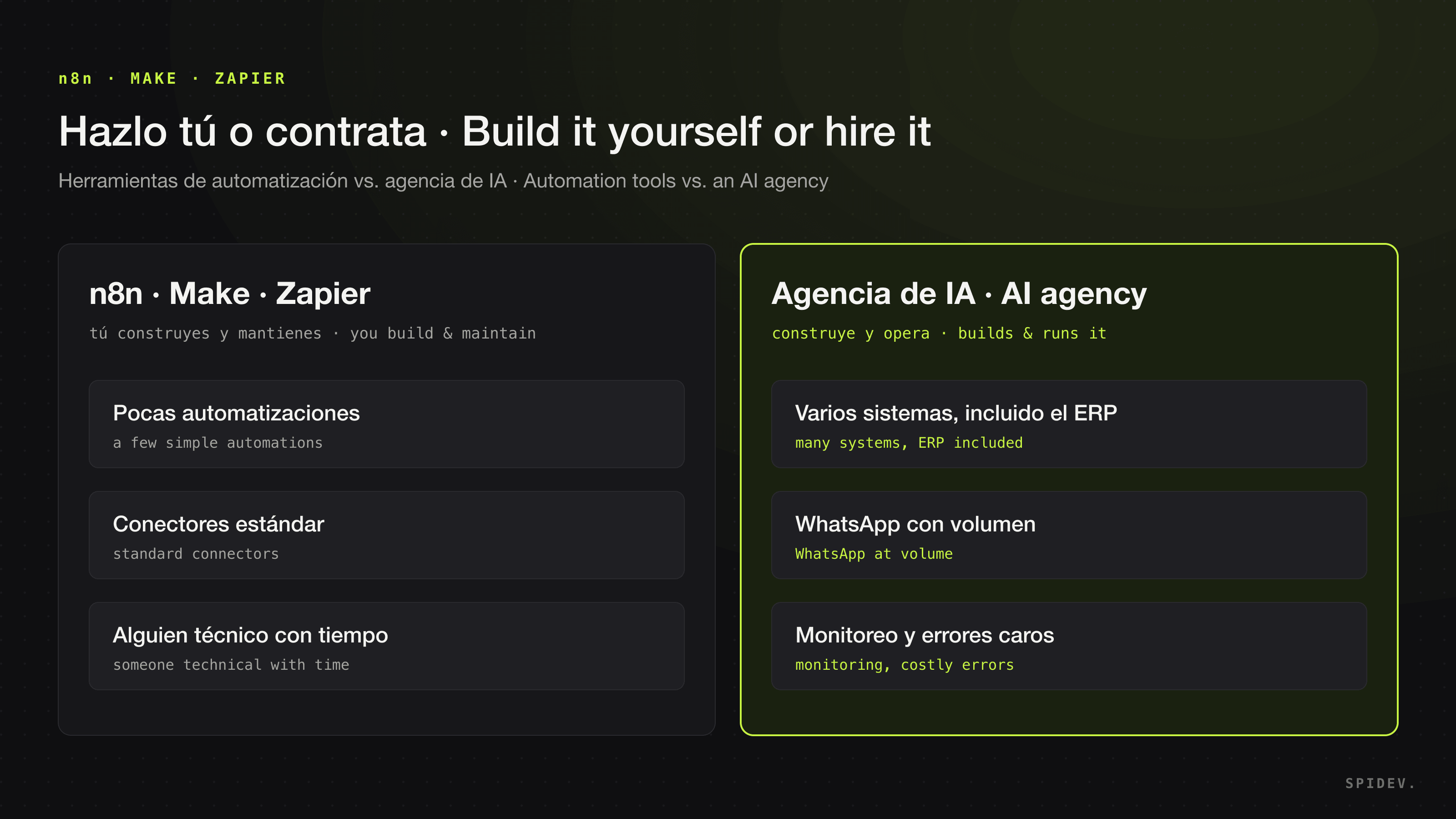
Short answer: if you need a few automations between well-known apps, someone technical on your team has time to maintain them and a mistake is cheap, do it yourself with Zapier, Make or n8n. If the process touches several systems — an ERP, in-house systems, WhatsApp at volume —, handles your customers’ personal data or a mistake is expensive, and nobody on your team will watch it, hire an agency that builds and runs it.
There is a middle path: an agency builds on a tool your team can read, with the accounts in your name. Below we compare the three tools using data from their official pages as of October 2026 and tell you when you do not need to hire anyone, us included.
What are n8n, Make and Zapier?
All three connect apps with “when A happens, do B” workflows, and all three now let you build AI agents. They differ in how they charge, where they run and how much technical work they ask of you.
What is Zapier and what does it cost?
Zapier is a cloud platform that connects more than 9,000 apps. It charges by task: one is counted each time it successfully completes a unit of work. As of October 2026, according to its pricing page, the Free plan includes 100 tasks a month and two-step workflows only; Professional starts at $19.99 a month billed annually ($29.99 billed monthly) for 750 tasks, and Team at $69 a month billed annually for 2,000 tasks.
For AI it offers Zapier Agents, which do not use tasks: they are billed in “activities”, any billable action an agent takes, with basic access on every plan and paid add-ons. Zapier hosts data on AWS servers in the United States and does not offer EU-only storage (Data Privacy Overview).
What is Make and what does it cost?
Make is a cloud platform with a visual builder where you create “scenarios”, its name for workflows. It charges in credits: most actions use 1 credit, and some advanced features that rely on Make’s AI Provider may use more. As of October 2026, its pricing page gives 1,000 credits a month on the Free plan and lists Core, Pro, Teams and Enterprise plans, cheaper when paid annually.
For AI it has Make AI Agents, built and debugged in the same canvas, with rules, manual approvals and points where you can stop the agent. According to its help center, the new app, Make AI Agent (New), is in open beta, and connecting your own AI provider requires a paid plan. When you create your organization you choose a US or an EU data center, and you cannot change it afterwards (organizations in Make).
What is n8n and what does it cost?
n8n runs in its own cloud, n8n Cloud, or installed on your server. It charges by execution: an execution is one full run of your workflow, however many steps it has. As of October 2026, according to its pricing page, Starter costs €20 a month billed annually for 2,500 executions a month and Pro €50 for 10,000, both on n8n Cloud; Business costs €667 a month billed annually for 40,000 executions and, for now, is self-hosted only. n8n Cloud stores data in the European Union, on servers in Frankfurt, Germany.
The free self-hosted version, Community Edition, uses the Sustainable Use License, which n8n describes as “fair-code”: it allows you to use or modify the software only for your own internal business purposes or for non-commercial or personal use. According to n8n’s license article, if only people in your organization create or edit workflows, you can use it for free; hosting n8n as a service for others or white-labeling it requires a commercial license.
For AI it has the AI Agent node, to which you connect a chat model and at least one tool. Its plan table includes human approval for tool calls on Starter, Pro and Enterprise.
n8n vs. Make vs. Zapier: how do they differ?
- Pricing unit: Zapier charges per task, Make per credit — most actions use one — and n8n per full workflow execution, however many steps it has.
- Self-hosting: of the three, n8n is the one you can install on your own servers. Zapier describes itself as a fully managed cloud, and Make as a SaaS platform where the vendor handles infrastructure, updates and scaling.
- AI agents: Zapier Agents, billed in activities; Make AI Agents, with its new app in open beta; and n8n’s AI Agent node.
- Learning curve: Zapier promises you can start building the day you sign up, and Make lets you build without code on a visual canvas. n8n Cloud needs no installation, but self-hosting it requires technical expertise.
- Who maintains it: on Zapier, Make and n8n Cloud, the vendor runs the platform and you run your workflows. On self-hosted n8n, the server is yours too.
None of them wins on everything: it depends on which apps you use, where your data must live and who will maintain the workflows.
When should you automate it yourself with n8n, Make or Zapier?
More often than an agency would tell you. Do it yourself if most of this is true:
- A few simple automations: sending form entries to a spreadsheet, alerting your team when a lead comes in or saving attachments to a folder.
- Someone technical with time: a person on your team who can build workflows and has hours set aside to review them, not just to build them.
- Low risk: if the workflow fails for a day, nobody loses money and no personal data is exposed.
- Standard connectors: your tools are well-known cloud apps that already have a ready-made integration on the platform.
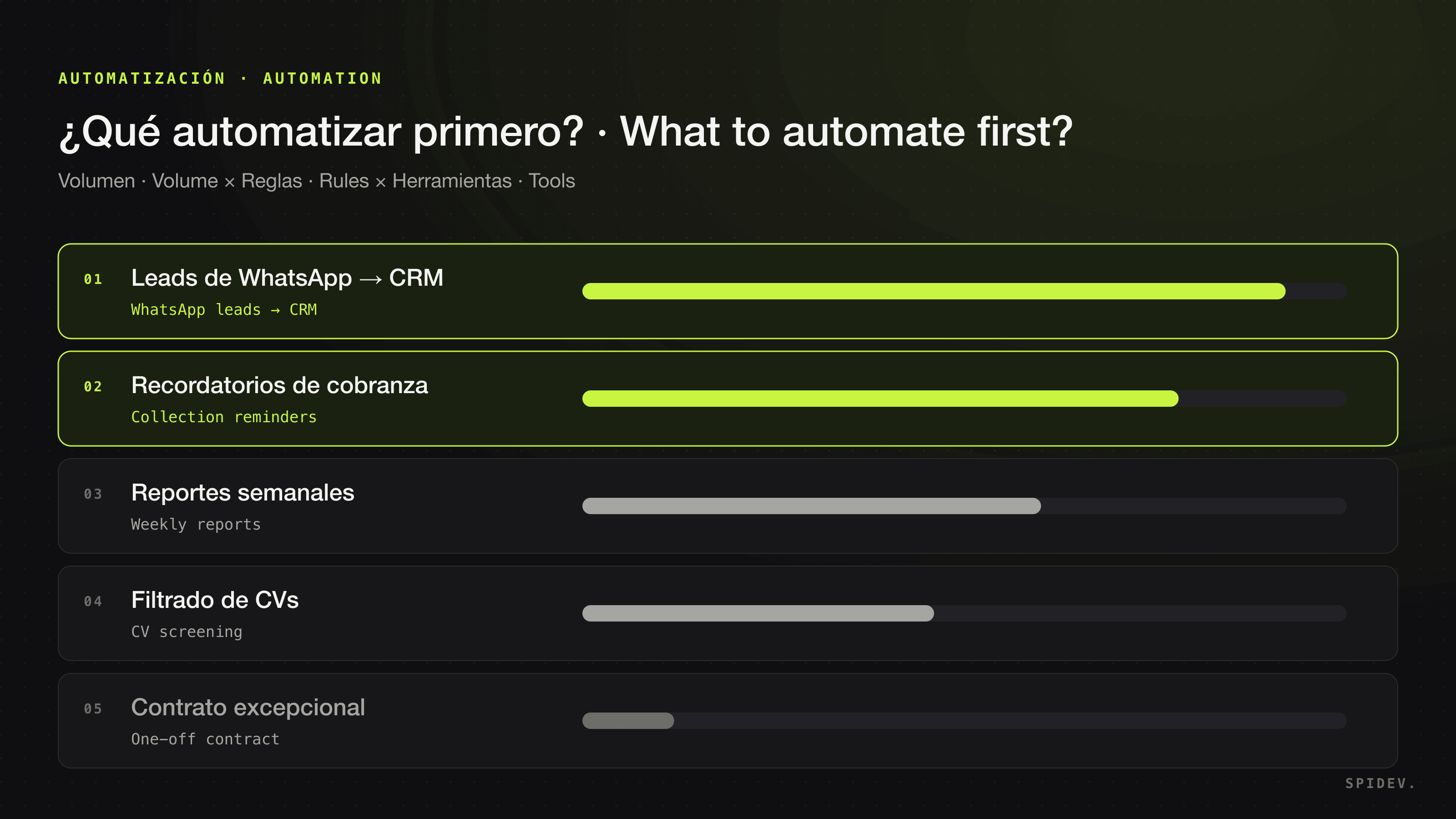
In that case, an agency is expensive for what you need. Start with the free plan of any of the three, measure how much time it saves you and upgrade when the volume justifies it. To pick which process to tackle first, use the exercise in which processes to automate with AI first.
When does it make sense to hire an AI agency?
When the problem stops being building the workflow and becomes integrating it, looking after it and answering for it:
- Many systems, including an ERP or in-house systems: if there is no ready-made connector, the work is in the integration, which a free plan does not solve.
- WhatsApp at volume: every conversation has to get a fast answer, check your CRM or inventory and follow Meta’s rules, which we explain in AI agents on WhatsApp Business in 2026.
- Customer personal data and compliance: who processes the data, where it is stored and which models receive it. The questions to ask any provider are in how to choose an AI company in Mexico.
- Nobody to watch it: if nobody on your team will review errors every week, the workflow breaks silently and you find out from a customer.
- Expensive errors: a duplicate charge, a wrong price or a candidate rejected without a person reviewing it.
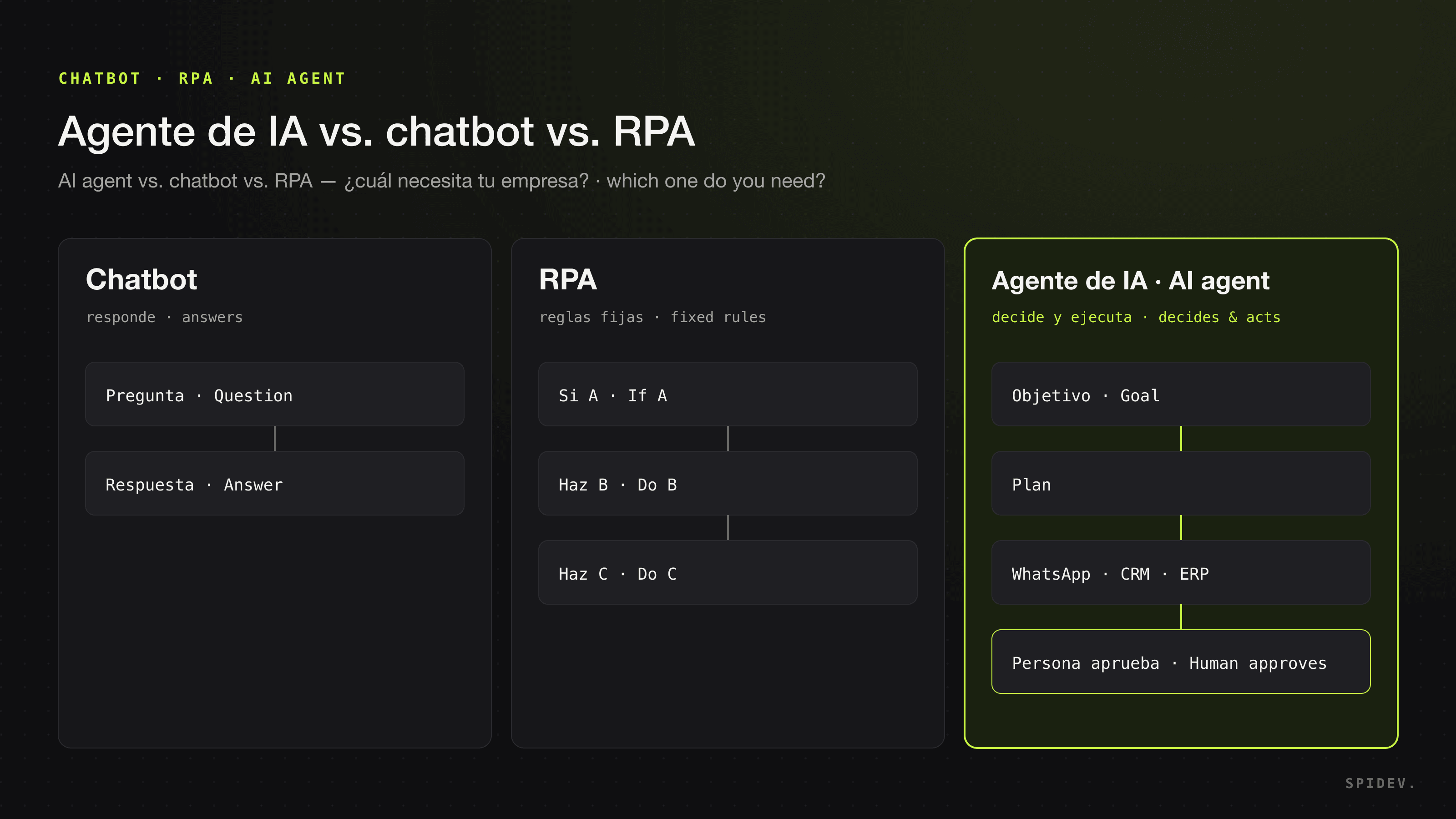
Another sign: if the process requires reading variable messages or documents and deciding what to do, it is no longer a rule-based workflow but an agent; we explain it in AI agent vs. chatbot vs. RPA.
What are the hidden costs of doing it yourself?
The tool’s plan is usually the cheapest part. What costs is everything else:
- Maintenance: apps change their APIs, fields and permissions, and a workflow that used to work stops without warning.
- Monitoring: someone has to check which executions failed, understand why and run them again.
- Error handling: what happens if an API does not respond, a duplicate record arrives or the AI model answers something off. Designing for that takes longer than the case where everything goes right.
- Usage that grows: Make warns that a scenario can use anywhere from two to thousands of credits in a single run. Check the pricing unit before you scale.
- The person who built it leaves: if the workflows live in their personal account and nobody else understands them, they leave with that person. Document them and keep the accounts in the company’s name.
And what are the hidden costs of an agency?
The main one is lock-in. Before you sign, ask:
- Whose name the accounts are in: the automation platform, the AI model keys and your WhatsApp Business account.
- Whether they hand over the workflows and code, and whether you can export them.
- Whether your team can read what was built or only the provider understands it.
- What documentation they deliver and what happens if you want to switch providers.
It is question 7 in our provider guide: any answer works if it is in writing. Also ask for implementation, operation and usage to be listed separately; we break down what drives the price in how much AI implementation costs.
Is there a middle path between doing it yourself and hiring an agency?
Yes. One option is for an agency to build on a tool your team can read — Zapier, Make or n8n —, with the accounts in your company’s name, and for your team to keep the system. The agency brings the design, the hard integrations and the error handling; your team learns to make small changes.
It works if it is agreed from the start: your accounts, documentation, a handover and clarity on who responds when something breaks. If you choose n8n, according to n8n a provider can install it on your company’s server as long as it does not also host it for you as a service. Another variant is to hire only the diagnosis and design — an AI consulting engagement — and build it yourself.
How we do it at Spidev
Spidev is an AI agent and automation agency based in Monterrey, Mexico, working with companies across Mexico and Latin America in Spanish and English. We design, build and operate agents and automations inside WhatsApp, CRM, ERP, email and spreadsheets, with 128+ integrations and with Claude, GPT or whichever model performs best. The first agents reach production in weeks, not months, and afterwards we monitor and tune them.
Each agent gets only the permissions it needs, with access through OAuth and encrypted keys; every action is logged and, where it matters, a person approves. See how we approach AI process automation, WhatsApp AI agents and our solutions by team.
The first consultation is free: book a call, we review your case and, if you can solve it yourself with one of these tools, we tell you. If it makes sense to build it with us, we deliver a proposal with fixed scope, timeline and price before charging anything. To compare providers, read our guide to AI agencies in Mexico.
Frequently asked questions
Should I use n8n, Make or Zapier, or hire an AI agency?
If you need a few automations between well-known apps, have someone technical with time to maintain them and a mistake is cheap, do it yourself with one of these tools. If the process touches an ERP or in-house systems, WhatsApp at volume or customer personal data, and nobody on your team will watch it, hire an agency that builds and runs it.
How does pricing differ between n8n, Make and Zapier?
They charge in different units: Zapier per task, Make per credit and n8n per full workflow execution. As of October 2026, Zapier Professional starts at $19.99 a month billed annually and n8n Starter at €20 a month billed annually; Make offers a Free plan with 1,000 credits a month and paid Core, Pro and Teams plans.
Is n8n free?
The self-hosted Community Edition is free under the Sustainable Use License, which allows use for your own internal business purposes or for non-commercial or personal use. You provide the server and maintain it; n8n Cloud and the Business plan are paid.
Can I build AI agents with Zapier, Make or n8n?
Yes. As of October 2026, Zapier has Zapier Agents, Make has Make AI Agents and n8n has the AI Agent node. Building the agent is the easy part; the hard part is connecting it properly to your systems, handling its errors and watching it in production.
Where do Zapier, Make and n8n store data?
Zapier hosts it on AWS in the United States and does not offer EU-only storage. In Make you choose a US or EU data center when you create your organization, and n8n Cloud stores it in Frankfurt, Germany; if you self-host n8n, it stays wherever you install it.
What should I ask an AI agency so I am not locked in?
That the accounts — the automation platform, the AI model keys and your WhatsApp Business account — are in your company’s name, that it hands over the workflows and code, and that it documents them so your team or another provider can maintain them.